
You know that moment when you open an email from a couple, read their question, and think, “Hang on. I wrote a really good explanation of this for someone else”? So you head to your sent folder, type in the three words you remember, and scroll until you find it.
The next time that happens, do yourself a favor. Before you copy your answer into a new email, open your blog drafts and paste it there, too.
As a wedding planner, I can happily talk a couple through the timing of family photos, where to put the bar, or what guests will do while the room is being set for dinner. Ask me to sit down on a Tuesday morning and come up with a blog topic, though, and somehow I can forget every question anyone has ever asked me. Give me an actual couple with an actual decision to make, and the words come right back.
I suspect you know the feeling. And if you’re heading into engagement season with “write more blog posts” somewhere on your to-do list, your sent folder is a good place to start. Here’s how I’d turn one email you’ve already written into a blog post couples can find, a Reel you can film, and a resource you’ll be glad to have the next time that question lands in your inbox.
Start with the question someone felt a little silly asking
Look for the emails that begin with “This might be a silly question, but…” or “We’re trying to figure out…” Those opening lines tell you something. A couple has reached a decision they don’t feel equipped to make. They may have asked a parent, compared notes with a friend who just got married, or looked at their venue paperwork. They’re emailing because they still need someone to help them think it through.
Here’s the kind of question I mean.
“Our ceremony starts at 4, and we put 5 on the invitations for the reception. My mom thinks people will be sitting around too long. Our photographer says we need time for pictures. Did we get this wrong?”
You can hear the worry underneath that email. They’ve already ordered the invitations. Two people they trust have given them advice that sounds contradictory. What they want to know is whether their guests will be taken care of and whether they’ll get to enjoy their own reception.
That’s a much more interesting starting point than a blank document titled Wedding Timeline Tips. It also gives you a headline in language another couple might actually type into a search bar: How Much Time Should We Leave Between Our Wedding Ceremony and Reception?
Show couples how you’d work through the answer
Let’s stay with that email for a minute. How would you answer if the couple were sitting across from you? I’d probably reach for a piece of paper and write down three times. When does the ceremony start? When will it end? And when you say the reception starts at 5, do you mean cocktails are available or everyone needs to be seated for dinner?
That last question changes the whole conversation. Here’s how part of the blog post could read:
Say your ceremony begins at 4 and ends around 4:30. If cocktails begin at 5 on the same property, the gap your guests will experience is about half an hour. Some of that time may go toward walking to the patio, finding the restroom, and greeting family. If dinner is being served at 5, that same half hour also needs to cover family photos, getting everyone seated, and getting the two of you into the room. I’d plan those two afternoons differently.
Now give readers one variation. What if the reception is across town? A directions app can tell them how long the drive takes. As the wedding pro, you can remind them to count the time it takes for the last row to leave the ceremony, reach the parking lot, drive over, park again, and find the right entrance. Picture a grandparent making that trip, and it’s much easier to see where an extra few minutes would help.
By this point, your reader has something they can actually do. They can take out their timeline, mark the end of the ceremony, and follow one guest all the way to cocktail hour. You’ve shown them how you think. For a couple deciding whom to trust with their wedding, that’s a pretty good introduction.
Give the post a title your couples would recognize
It’s easy to slip into industry language when we sit down to write. You might call something a “room flip” at a vendor meeting. A couple touring a venue is more likely to ask, “Where do our guests go while you turn the ceremony room over for dinner?” I’d use the couple’s question as the title. You can teach them the term room flip once they’re reading.
This works across wedding businesses. A stationer might find an email asking, “Do we need a wedding invitation for every guest or every household?” A photographer might have a thoughtful reply to “Can we get family pictures done quickly if our parents are divorced?” A venue owner may have answered “Can we see what the indoor ceremony space looks like when it’s set up for rain?” three times this month. Each one could carry a post on its own. That venue post could be especially helpful with photos showing the actual setup from the back row, right where a guest would see it.
When you turn a private reply into public content, carry over the question and your expertise. Leave names, dates, family circumstances, and identifying details in the inbox. For the photographer’s post, for instance, you can explain how you collect family groupings in advance without sharing anyone’s private history.
Let the blog post, the Reel, and the email each do a different job
Your blog has room for examples and the “it depends” parts of your answer. A Reel works best when you pull out one detail someone can grasp while scrolling. For the timeline post, I’d film this one straight to camera with a handwritten timeline in hand:
“If your ceremony starts at 4 and cocktails start at 5, your guests don’t have a full hour to fill. What time does your ceremony end? Write that down first. Then walk through what happens between the last kiss and the first drink. That’s the part of the timeline I’d double-check with your venue.”
That’s the whole Reel. Add the blog title to your caption and tell people where to find the full example. You’ve given someone a helpful answer even if they never leave Instagram.
Then save a short email reply for the next couple who asks. I’d write something like this:
“Since your ceremony and reception are both at the venue, I’d start by checking what time the patio will be ready for guests. I wrote a guide that walks through this exact timing question, and the same-venue example is the one I’d look at first. Here’s the link. Once you hear back about the patio, send me the time and we’ll see how it lines up with family photos.”
The personal sentence matters. It tells the couple you remember where they’re getting married and what they’re trying to solve. The link gives them something they can share with the parent who’s worried, too.
Your plan of action for this week
Here’s how I’d fit this into a working week, especially if you’ve got client meetings on the calendar and a wedding this weekend.
Monday: Spend 15 minutes in your sent folder. Search for phrases you use when you’re explaining something, like “I usually recommend,” “a good rule of thumb,” or “what I’d suggest.” Write down five questions you’ve answered. Choose the one you’d most like to have a link for the next time it comes up. That’s your first post.
Tuesday: Draft the answer like an email. Put the couple’s question at the top of the page. Answer it in the first paragraph, then walk through one example. Add the detail that would change your advice and finish with one thing the reader can do. If the writing starts to feel stiff, imagine your favorite client has just asked you the question over coffee. What would you say first? Use that sentence.
Wednesday: Edit and publish. Read the draft aloud. Swap out any phrase you’d never say to a couple. Check that the title names the question clearly and that any timing or service details are accurate for your business. Add a relevant photo you have permission to use. Once the post is live, open it on your phone and make sure the example is easy to find.
Thursday: Film one takeaway. Choose the sentence you’d underline if you handed the article to a client. Use it as the opening line for a short Reel. A planner can point to a timeline. A stationer can hold up an envelope and explain why the household count matters. Give the viewer one idea they can use today.
Friday: Put the link where you answer email. Save a draft reply or add the post to the shared document your team already uses. Include a reminder to personalize the opening line. Keep your other four questions in the same place, so when you sit down to write again, you already have somewhere to start.
After a few weeks, pay attention to what comes back. Does a couple reply, “That’s exactly what we needed”? Does your venue coordinator reach for the same post after every tour? Does someone read the article and ask a follow-up you hadn’t thought to cover? Those responses tell you which posts are earning their place in your business and what might deserve a post of its own.
At The Social Attendant, this is one of my favorite places to start with a wedding pro who wants help keeping up with their content. You’ve spent years learning what couples need to know. The thoughtful answer you wrote between a walkthrough and a vendor call deserves a little more mileage.
Next time you catch yourself thinking, “I know I’ve answered this before,” go find that email. Your next blog post starts there.
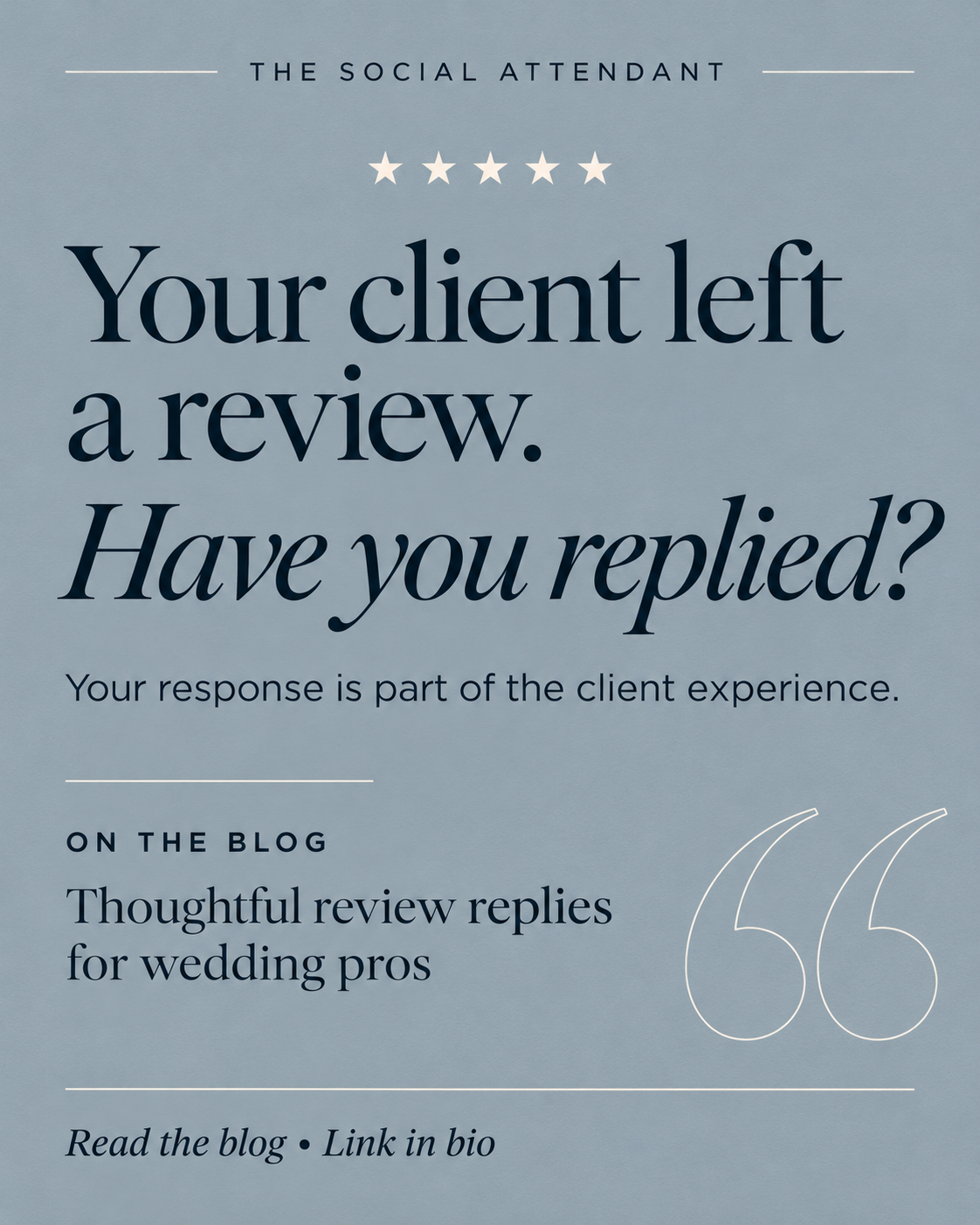
Your client experience includes what happens after the wedding
Think about what it takes for a couple to leave a thoughtful review.
They’ve just finished planning a wedding. They might be traveling, catching up at work, writing thank-you notes, or enjoying the novelty of having a conversation that doesn’t involve a seating chart.
And they’ve chosen to spend a few minutes telling other people about your business.
Sometimes they write paragraphs. They mention your team by name. They describe how you helped them feel calm or how their families are still talking about the day.
That’s a generous thing to do.
A personal reply acknowledges the time they took and the relationship you built. It gives you one more opportunity to say, “We loved being part of this, too.”
You don’t need to write something elaborate. You do need to make it feel like you read what they shared.
Future clients are reading your responses, too
Picture a couple comparing two wedding venues.
Both have beautiful photographs. Both fit their guest count. Both have reviews from happy clients.
As they scroll, they also get a glimpse of how each business communicates. Are the responses warm? Specific? Thoughtful when something went wrong?
Your replies become part of the information someone uses to get comfortable with you.
Google’s own guidance notes that helpful, positive review replies can show customers that a business is responsive. That’s a useful way to approach this: your response is a small, public example of how you care for people.
Wedding clients are choosing people they’ll trust with a meaningful day. Your words can help them picture what it would feel like to work with you.
How to reply to a positive review without sounding like everyone else
“Thank you for your kind words!”
There’s nothing wrong with that sentence. But when it’s the entire response to a detailed, heartfelt review, it can feel a little thin.
A useful structure is:
Thank the client.
Acknowledge something specific they mentioned.
Close with a warm, genuine sentiment.
For example, if a couple praises how smoothly their wedding day ran, a planner might write:
“Thank you, Emily! Knowing you felt relaxed and able to enjoy the day means so much to us. We put a lot of care into those behind-the-scenes details, and we’re so glad that support came through. It was a joy to celebrate with you both!”
A venue responding to praise about its staff might say:
“Thank you, Alex! We’re so happy you and your guests felt welcomed and cared for. I’ll make sure our team sees your lovely words about their help throughout the evening. Thank you for choosing to celebrate here!”
These are starting points. The best detail will come from the actual review and your relationship with that client.
Before you post, ask yourself: Could this response belong under almost anyone’s review?
If the answer is yes, add one specific acknowledgment.
Match the response to what they shared
A five-star rating with no written comment doesn’t require a paragraph.
“Thank you for the five stars, Taylor! We appreciate you taking the time to support our business.”
That’s enough.
A longer review gives you more to respond to, but you still don’t need to address every sentence. Choose the part that carries the most meaning.
If they say your planning support helped them feel less overwhelmed, acknowledge that relief. If they praise your venue coordinator by name, recognize that person.
Pay attention to the experience they’re describing. Couples might mention the beautiful ceremony space, but they may spend even more time talking about the staff member who made sure their grandmother was comfortable.
That tells you something about what they’ll remember.
Keep private details private
Personal replies should still respect boundaries.
A client might publicly thank you for helping them navigate a difficult planning process. That doesn’t mean your response should explain the family conflict, budget concerns, or vendor issue behind it.
You can say:
“We’re so glad you felt supported throughout the planning process.”
You don’t need to share what made that support necessary.
Use details the reviewer has already chosen to make public, and be thoughtful about adding anything else. The goal is to help them feel appreciated, not unexpectedly exposed.
Give yourself a realistic response routine
My practical recommendation is to aim for a reply within two business days when you can.
That’s a working goal, not a reason to interrupt a wedding or spend your Sunday evening monitoring notifications.
Turn on review alerts for the platforms where your business is listed. Then give those alerts somewhere to go besides the growing pile of unread emails.
You might check reviews during your Monday and Thursday admin time. Someone on your team might flag new ones and prepare replies for your approval.
The important part is deciding:
Who checks for new reviews?
Who writes the response?
Who handles feedback that needs more attention?
“Whoever sees it first” can easily turn into “I thought you were doing it.”
A small, clear process makes this easier to maintain during a busy season.
Yes, you can reply to an older review
If you’re reading this and thinking about the reviews you haven’t answered since June, take a breath.
Start where you are.
You don’t need to make your delayed response a lengthy explanation of how busy you’ve been. Keep the attention on the client.
Something like this works:
“I’m catching up on replies and wanted to make sure I thanked you for this thoughtful review. We’re so grateful you trusted us with your wedding, and hearing that you felt so well cared for means a great deal.”
Work through a few at a time. Give yourself a manageable way to catch up, then establish a routine for new reviews.
This is a task you can recover from.
When a review is difficult, pause before you reply
A negative review can feel deeply personal when you know how much work went into that wedding.
You remember the extra calls. The last-minute changes. The problem your team solved before most guests even noticed.
It’s understandable to want to explain all of it.
Give yourself a little room before you do.
Read the review, step away, and look into what happened. Check the relevant communication and speak with the team members involved. You want your response to reflect what you know, rather than what you feel in the first five minutes.
When there’s a valid concern, acknowledge it clearly.
For example, if you’ve confirmed that communication was delayed:
“Thank you for sharing this, Morgan. I’m sorry our communication in the final weeks left you feeling uncertain. We should have been clearer about when you could expect updates. I’d appreciate the opportunity to speak with you directly and better understand your experience. Please contact me through our office email.”
Then follow through.
If you say you’re reviewing a process, review it. If you invite a conversation, make time for it.
The public reply is only one part of addressing the concern.
You don’t have to publish the entire backstory
Sometimes a review includes information you disagree with.
You can clarify a relevant fact without posting a point-by-point rebuttal, quoting private emails, or walking readers through the entire contract.
Ask yourself what someone reading the exchange actually needs to understand.
Usually, they need to see that you took the concern seriously, communicated respectfully, and offered an appropriate next step.
Have a trusted colleague read a difficult response before you publish it. Ask, “Does this sound calm and helpful?”
That second set of eyes can catch the sentence that felt perfectly reasonable while you were frustrated.
If a review appears to violate a platform’s rules, use its reporting process. On Google, reviews can be flagged for policy violations, though disagreement with a review alone doesn’t establish a violation.
Use templates to get started, then make the reply yours
A blank response box can make a two-minute task take twenty.
Keep a few starting points for common situations: a short five-star rating, detailed praise, a team shout-out, or mixed feedback.
Then adjust the wording to the actual review.
Read it aloud before posting. Would you say this to the client? Does it sound like your business?
Phrases like “We strive to exceed expectations” rarely tell someone much about the people behind the reply.
“We’re so glad you felt comfortable asking questions along the way” says something more specific and human.
Also, resist turning your thank-you into a sales pitch. The couple has given you a compliment. Let them have that moment without adding a list of services or an invitation for everyone reading to book a tour.
Let reviews help you run a better business
Reviews can show you what clients notice, value, and struggle with.
Once a month, look for patterns.
Are couples repeatedly praising your clear timelines? Make sure that part of your service gets attention in consultations.
Does your venue team regularly receive compliments for helping older guests? Share that feedback with them.
Are several people mentioning confusion about the final walkthrough or uncertainty about who to contact? Take a closer look at that part of your process.
Bring the positive feedback to your team, too. The person answering questions, checking place settings, or staying late to help may never see the review unless you share it.
Recognition matters, especially after a demanding weekend.
Make room for the follow-through
I know replying to reviews can feel like one more thing on an already full list.
It’s also the kind of task that becomes easier when someone owns it, there’s a simple process, and you have support.
Someone can monitor your reviews, draft thoughtful responses in your voice, and bring sensitive feedback to your attention. You can stay involved where your perspective matters most without being responsible for remembering every notification.
That’s how I approach support at The Social Attendant: paying attention to the details that help wedding planners and venue owners care for their clients while protecting their own time.
For now, start small. Open your reviews. Find one that hasn’t received a response. Read what that person took the time to say.
Then write back.
And if keeping up with these details has become harder as your business has grown, take a look at Client Concierge support. You deserve a process that helps you follow through without adding more to your evenings.

At The Social Attendant, we’re passionate about supporting wedding professionals through smart social media, streamlined systems, and behind-the-scenes support that actually makes life easier. Founded by Lori Losee, an award-winning wedding planner with more than 20 years of industry experience, TSA has been helping wedding creatives grow, scale, and stay visible since 2020 through social media management, coaching, and virtual assistant support. If you’re ready to feel more supported and take your business to the next level, we’d love to connect.